Market commentary bonds: big promises, few results – America’s quarter in reverse
The US’s once ambitious plans to reduce deficits, strengthen the economy and defuse conflicts have turned into trade wars, mounting new debt and fresh conflicts. In his market commentary, Dr Harald Henke, Head of Fixed Income, explains the impact on bond markets.

Dr. Harald Henke
Principal Investment Strategist Fixed Income
Key takeaways
-
The US government’s ambitious plans to reduce deficits and strengthen the economy turned into budget chaos, exploding defence spending and an escalating trade war within a quarter.
-
US interest rates rose significantly, while Europe saw falling short-term rates thanks to ECB cuts – the divergence also reflects the inflationary consequences of US tariff policy.
-
Despite political turmoil and geopolitical risks, credit spreads remained stable, supported by robust corporate balance sheets and the resilience of global corporations.
Three months ago, we discussed the US government’s promising efforts to reduce the budget deficit, defuse geopolitical conflicts and increase the competitiveness of the US economy. However, we also emphasised that it remains to be seen whether these approaches will be followed by action. Three months later, there is not much hope left and chaos is reigning.
Political environment
As in previous quarters, the political environment was largely characterised by events in the USA. At the beginning of the year, the US government announced initiatives to reduce the budget deficit, in particular by cutting the defence budget and curbing wasteful spending. In addition, the competitiveness of the US economy was to be increased through technological initiatives, tax cuts and the reduction of bureaucracy, geopolitical conflicts were to be defused and the immigration problem tackled. Three months later, progress has failed to materialise. The US government’s policies look increasingly chaotic.
- Instead of strengthening the competitiveness of the US economy through internal reforms and cost reductions, the government triggered a global trade war at the beginning of April. While China was the main target of the measures, countless other countries were hit with tariffs based on the size of their trade surplus with the US. These measures triggered a sell-off on the stock markets and a widening of credit spreads. Negotiations between the individual trading blocs are underway – with an uncertain outcome.
- The US government’s budget was met with disappointment. The defence budget continues to grow, with new major projects such as a missile defence shield for the entire USA at a cost of hundreds of billions of USD are being discussed. In the short term, tax cuts will lead to an increase in the deficit. Meanwhile, tensions are rising between President Trump and the Department of Government Efficiency, which is responsible for making savings. Currently, there are no signs of consolidation efforts.
- There is also chaos in geopolitics. The US has no recognisable strategy in the conflicts in Ukraine and the Middle East. Within the US government, there is a multitude of different voices, and it seems to be splitting into two camps. President Trump does not appear to be bringing order to the confusion. Instead, he has abandoned the peace platform on which he won the presidential election and has made symbolic attacks on Iran. This could have escalated into a wider war, resulting in a dramatic rise in oil prices and a corresponding impact on the global economy.
Implications for interest rates: Diverging paths for USA and Germany
Figure 1 illustrates the differing impact of these events on interest rate markets in the USA and Europe:
Figure 1: Two-year and ten-year interest rates in the USA and Germany

At the start of the quarter, German interest rates fell after rising significantly in March following the announcement of the German fiscal package. The ECB made a further interest rate cut. Overall, interest rates in Europe were slightly lower over the quarter.
In the US, however, there was an increase over the quarter. According to general estimates, the inflationary impetus of the customs policy is likely to be most evident in the USA. This has resulted in an interest rate move being priced out at the short end of the yield curve.
Figure 2 shows the divergence most clearly in the 30-year yield.
Figure 2: 30-year yields in the US and Germany
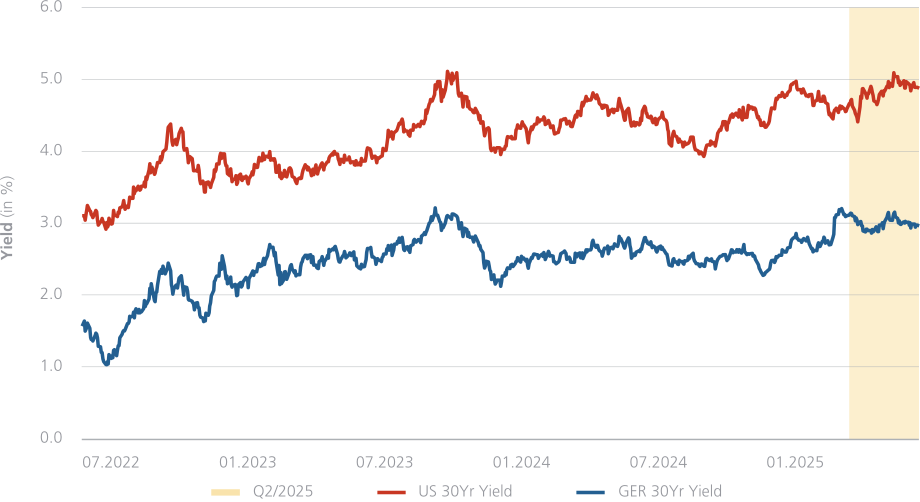
While long-term interest rates in Germany have remained stable, they have risen steadily in the USA. During the quarter, they even briefly exceeded the symbolic 5% threshold, closing slightly below it. The majority of market participants anticipated further increases in long-term US interest rates in the second quarter.
Consequently, the US Federal Reserve did not adjust its key interest rates. Uncertainty about the future course of US economic policy and its impact on inflation is causing central bankers to act cautiously. The US government’s growing criticism of the central bank is exacerbating this uncertainty.
In mid-June, the Federal Reserve published its members’ forecast for future interest rates. Figure 3 shows the median estimate:
Figure 3: Median of Fed members’ interest rate path estimates

Market uncertainty has not yet led to a reduction in the expected number of interest rate hikes for 2025. The US Federal Reserve still expects two interest rate cuts by the end of the year. However, the path of interest rates over the next two years is being assessed more cautiously: For both 2026 and 2027, one downward step of 25 basis points each has been priced out.
Credit spreads weathering the turbulence
Recent developments have not yet led to a noticeable weakening of the economy. Labour markets remain robust and purchasing managers’ indices are in expansionary territory in the USA or approaching it in Germany. Inflation rates and inflation expectations remain moderate.
Accordingly, investment grade corporate bond spreads also remained supported and weathered the turbulence surrounding the trade war at the beginning of April much better than equity markets did.
Figure 4: Credit spreads
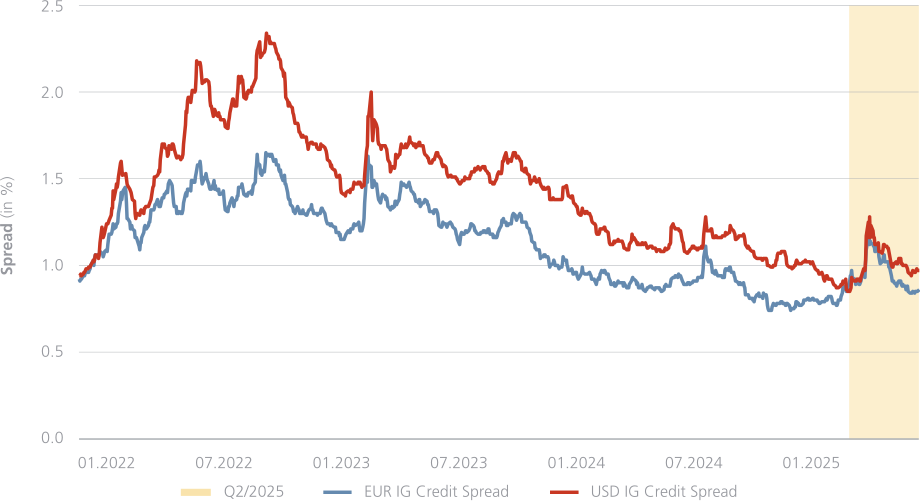
Following the rise in spreads at the beginning of April, which peaked at an increase of just under 30 basis points, a rally ensued that lasted until the end of the quarter, bringing the spread level back to its initial point. The credit markets were unimpressed, quickly shaking off the volatility thanks to the strengthening of corporate balance sheets in recent years.
Conclusion
The second quarter of 2025 was characterised by chaotic economic and foreign policy. Nevertheless, the markets coped well with the volatility, quickly overcoming concerns about tariff increases and rising oil prices in connection with the wars in the Middle East. However, geopolitical risks remain high, and crises could flare up or escalate at any time. Prudent behaviour on the part of market participants therefore remains key to success.
Large global companies are best placed to cope with these turbulent markets. With production sites and sales markets around the world, they can circumvent political actions much more easily than national governments can, minimising their impact on the company’s bottom line. Apple for instance is one such company: it proposed shipping iPhones from China to India for final assembly, declaring them as Indian exports to avoid tariffs on Chinese imports. Global corporate bonds are therefore likely to remain in demand in the current environment.