Credit spreads, dispersion and the detection of technology bubbles – Dotcom era vs. AI cycle
Do credit spreads contain early warning signals during technology-driven equity booms? A comparison of the Dotcom era and the current AI cycle shows that spreads primarily signal financial fragility in stress regimes – not valuation excess.

Dr. Harald Henke
Principal Investment Strategist Fixed Income
Key takeaways
-
Spreads measure fragility – not exuberance: Credit reflects default risk, not elevated valuations alone.
-
The signal emerges in stress regimes: Investment Grade excess spreads predict equity weakness primarily in downside markets.
-
Dispersion warns only when risk accumulates: During the Dotcom cycle yes – in the AI cycle, not so far.
1. Introduction
Technology-driven equity booms repeatedly raise the same question: do financial markets signal emerging fragility before prices correct, or do they collectively participate in exuberant valuation expansion? The collapse of the IT and telecom bubble in 2000–2002 remains one of the most dramatic episodes of valuation reversal in modern capital markets. The recent artificial intelligence (AI) cycle has once again triggered debate about whether markets are witnessing a structural productivity transformation or the formation of another technology bubble.
Credit markets are frequently viewed as more disciplined than equity markets. Equity holders benefit from unlimited upside, whereas bondholders are primarily exposed to downside risk. In structural capital structure models, credit spreads respond directly to asset volatility, leverage and distance to default. If fragility accumulates beneath rising valuations, credit spreads should widen before equity markets decline.
However, this intuition requires refinement. If equity markets rise because discount rates fall or valuation multiples expand without simultaneous deterioration in balance-sheet resilience, credit spreads may remain stable. Credit spreads measure default risk, not valuation excess. The distinction between fragility and valuation is therefore central.
This study investigates whether IT-sector credit spreads — and, crucially, their cross-sectional dispersion — contain early warning signals during two technology cycles:
- The Dotcom period (1997–2001)
- The AI period (2025–2026)
Investment Grade (IG) and High Yield (HY) bonds are analysed separately in the empirical part.
2. Technology cycles: 2000 versus 2026
2.1 The Dotcom episode
The late 1990s were characterised by extraordinary equity valuation expansion in internet and telecom firms. Telecom operators financed infrastructure expansion with substantial debt issuance, including large volumes of high-yield bonds. The NASDAQ peaked in early 2000 before collapsing sharply.
Credit spreads widened dramatically only once refinancing conditions tightened and defaults materialised. During the euphoric build-up phase, spreads remained comparatively contained. This raises the question whether credit markets provide early warning signals during valuation booms or whether they respond primarily once fragility becomes tangible.
2.2 The AI cycle
The current AI-driven rally differs structurally. The leading firms are highly profitable and maintain strong balance sheets. Leverage remains moderate relative to the telecom expansion of the late 1990s. While capital expenditure is elevated, internal financing capacity is substantial. In this environment, it is not obvious that spreads should widen unless fragility genuinely increases.
3. Theoretical framework
3.1 Structural credit risk and the Merton model
In the Merton (1974) framework, equity can be interpreted as a call option on firm assets, while debt equals a risk-free bond minus a put option on firm assets:

where ET and BT denote the values of equity and debt, respectively, at maturity T, VT is the value of the firm’s assets at time T, and D is the nominal value of debt due at maturity.
Figure 1 displays the payout profile of the bond and the equity of the company as a function of the value of the company’s assets.
Figure 1: Payout profile of asset classes in the Merton model
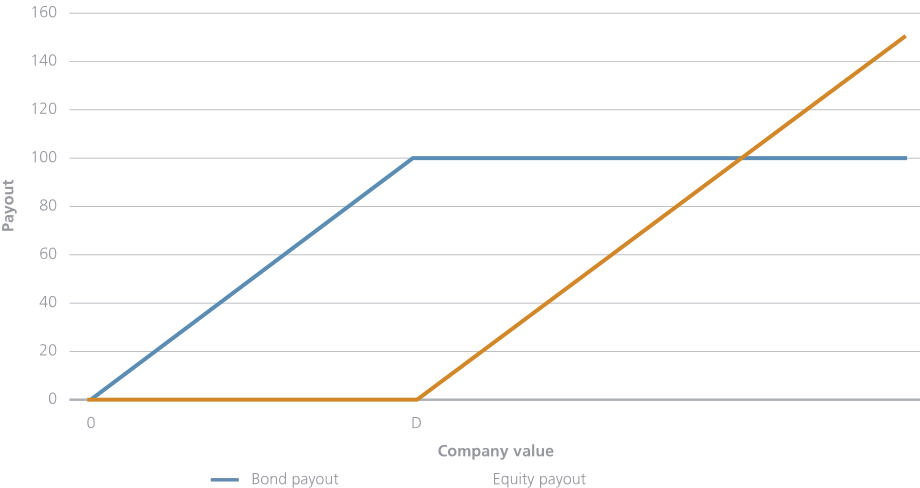
The payout of the bond is capped to the upside at the face value of the debt (assuming a zero coupon bond here for the sake of simplicity) but drops to zero with declining company value. The equity, on the other hand is a subordinated claim to the bond with limited upside but capped to zero to the downside. That explains why credit spreads and equity of the same company show different dynamics:
In particular, credit spreads of the company increase with:
- higher asset volatility,
- higher leverage,
- reduced distance to default.
Crucially, valuation expansion alone does not imply higher spreads. If asset values rise relative to debt, leverage may decline, and spreads may compress. Therefore, we can conclude that credit spreads are indicators of fragility, not of valuation exuberance.
3.2 Dispersion as a proxy for latent volatility
If asset volatility increases heterogeneously across firms, cross-sectional dispersion in spreads should rise. This dispersion can be measured in two different ways:
- Dispersion of levels: the standard deviation of credit spreads.
- Dispersion of changes: the standard deviation of credit spread changes.
In structural models, rising volatility should predict subsequent widening in average spreads, especially for lower-rated firms. Cross-sectional dispersion in spreads or spread changes may proxy for heterogeneous increases in asset volatility and thus potentially serve as an early warning signal of subsequent widening.
3.3 Sector-specific excess spreads
Macro credit shocks affect all sectors. To isolate technology-specific fragility, we define:

i.e., the excess IT sector spread change is defined as the spread change in the sector minus the average spread change in the market. If IT-sector fragility increases, excess spreads should widen and predict sector underperformance. Therefore, the excess credit sector spread change should be an important variable to incorporate into any analysis on the information content of credit spreads.
4. Data and methodology
IT-sector credit spread indices are constructed from bond-level data. We use the ratings of the three large rating agencies Moody’s, Standard & Poor’s and Fitch to determine the worst rating of the three for classifying bonds either into the IG or HY samples. We use daily credit index spread data from Bloomberg and ICE. For the Dotcom period (1997 – 2001), we have only reliable bond level data on a monthly basis. For the AI period (2025 – mid-February 2026) we use daily index components. All individual bond level data are from ICE. Equity returns refer to the NASDAQ stock index.
To answer our question whether credit spreads contain information on subsequent equity returns, we conduct the following analyses:
- Predictive regressions of equity returns on lagged spread changes,
- analyses of sector-excess spreads and spread changes,
- regressions of spread changes on lagged dispersion, and
- the following asymmetric regression:

where the equity return, rt, is regressed on the previous period spread, change, ∆st-1, with the coefficients split into the case where this equity return is positive and where it is negative, to check for asymmetric effects in downside and upside markets.
5. Empirical results
We report results for the Investment Grade (IG) and the High Yield (HY) sectors, respectively, and for the two periods comprising the dotcom bubble (1997–2001) and the AI bubble (2025–2026, daily and weekly). We conduct the four analyses described above.
5.1 Predictive regressions: Absolute and excess spread changes
5.1.1 AI period (daily)
We estimate:

and

The results are displayed in table 1.
Table 1: AI period — daily predictive regressions
| Sample | Specification | β (Spread term) | p-value |
|---|---|---|---|
| IG | Raw IT spread | −0.459 | 0.014 |
| IG | Excess IT spread | −0.449 | 0.014 |
| HY | Raw IT spread | −0.008 | 0.003 |
| HY | Excess IT spread | −0.009 | 0.046 |
For IG we find:
- A 10 bps widening (0.10%) predicts roughly a −4.6 bps next-day NASDAQ return.
- The result remains essentially unchanged when using excess spreads, confirming that the signal is sector-specific.
For HY, the results show:
- HY spreads are statistically significant but economically negligible in magnitude at the index level.
- A 10 bps widening predicts less than 1 bp change in NASDAQ.
Thus, IG spreads carry economically meaningful predictive information at daily frequency; HY spreads do not at index level.
5.1.2 AI period (weekly robustness)
We aggregate data for the 2025/26 period on a weekly basis and repeat the analysis using excess IT spreads.
Table 2: AI period — weekly excess spread regressions
| Sample | β (excess IT spread) | p-value |
|---|---|---|
| IG | −0.480 | 0.019 |
| HY | −0.078 | <0.001 |
The results show:
- IG weekly excess spreads remain economically large.
- HY becomes statistically stronger at weekly frequency but still economically smaller in magnitude than IG.
This suggests the IG signal reflects systematic fragility, while HY contains more noise. As the NASDAQ contains the largest tech companies, high yield spreads may contain information that is less relevant for large NASDAQ companies.
5.1.3 Dotcom period (monthly)
We also repeat the analysis using monthly data for the dotcom period.
Table 3: Dotcom — monthly predictive regressions
| Sample | Specification | β | p-value |
|---|---|---|---|
| IG | Raw IT spread | +0.046 | 0.53 |
| IG | Excess IT spread | +0.051 | 0.49 |
| HY | Raw IT spread | +0.012 | 0.06 |
| HY | Excess IT spread | +0.011 | 0.06 |
Interpretation:
There is no robust predictive evidence at monthly frequency. HY coefficients are positive and only borderline significant at monthly frequency. This sign is not consistent with a clean fragility-leads-equity interpretation and likely reflects the low frequency of the data and the limited sample size.
5.2 Asymmetry of spread effects
Next, we investigate the asymmetries in the relationship between spreads and equity returns by estimating equation (3) above. We display the results in table 4:
Table 4: Asymmetric spread–equity sensitivities
| Period | Sample | β down | p-value | β up | p-value |
|---|---|---|---|---|---|
| AI (daily) | IG | −0.274 | 0.028 | −0.024 | 0.778 |
| AI (daily) | HY | −0.029 | 0.054 | −0.004 | 0.272 |
| Dotcom (monthly) | IG | −0.109 | 0.085 | +0.116 | <0.001 |
| Dotcom (monthly) | HY | +0.008 | 0.071 | +0.010 | 0.603 |
We obtain the following results:
- In the AI period, IG spreads significantly affect equity returns only in down markets.
- Effects in up markets are negligible.
- HY shows weaker asymmetry.
- In Dotcom, IG down-state coefficient is economically meaningful but only borderline significant (probably due to the limitations posed by the use of monthly data).
- The strongly positive coefficient in up-state months likely reflects reversal dynamics and the limitations of monthly aggregation rather than a structural spread–equity mechanism.
This confirms the structural prediction: spreads matter primarily when fragility materialises.
5.3 Dispersion as a fragility signal
We test whether cross-sectional dispersion predicts subsequent widening by utilising the two measures described in section 3.2.
5.3.1 AI period (daily data)
Table 5: AI — dispersion predicting spread widening (selective display)
| Sample | Test | Coefficient | p-value |
|---|---|---|---|
| IG | Standard deviation of credit spreads | −0.018 | 0.29 |
| HY | Standard deviation of credit spread changes | −0.065 | 0.040 |
The findings show:
- No consistent positive relationship.
- HY shows significant but negative coefficient (mean reversion).
- Dispersion does not function as a warning signal in the AI period.
5.3.2 Dotcom period (monthly data)
Table 6: Dotcom — dispersion predicting spread widening (selective display)
| Sample | Test | Coefficient | p-value |
|---|---|---|---|
| IG | Standard deviation of credit spreads | −0.161 | 0.055 |
| HY | Standard deviation of credit spreads | +0.047 | 0.037 |
| HY | Standard deviation of credit spread changes | +0.380 | <0.001 |
For the monthly dotcom data, we obtain the following results:
- For HY, dispersion significantly predicts future widening.
- This is exactly what structural theory predicts when fragility rises.
- For IG, results are weaker and partly opposite-signed.
Thus, we can summarise the differences between the two periods as follows:
| Regime | HY dispersion → widening |
|---|---|
| Dotcom | Yes |
| AI | No |
Dispersion functions as a fragility signal only when default risk becomes binding.
6. Results summary
If we sum up the empirical results, we find:
- IG excess spreads predict equity weakness in the AI period.
- Asymmetry is strong for IG in AI period.
- Dispersion predicts widening in HY during the Dotcom period.
- Dispersion does not predict widening in the AI period, consistent with the absence of systemic fragility.
The quantitative evidence, therefore, supports a regime-dependent view:
- Credit spreads — especially sector excess spreads — predict equity weakness when fragility materialises.
- Cross-sectional dispersion acts as a warning signal in lower-rated segments when volatility rises.
- During valuation-driven expansions without rising default risk, neither spreads nor dispersion consistently lead equity markets.
7. Conclusion
Credit spreads are not universal bubble detectors. Their predictive power depends on:
- the presence of financial fragility,
- the rating segment,
- whether volatility and leverage are rising.
In the AI cycle, IG excess spreads contain short-horizon information, primarily in downside regimes. Dispersion does not signal systemic instability in this regime. In the Dotcom episode, HY dispersion predicted subsequent widening, consistent with volatility-driven fragility dynamics.
The central conclusion is therefore:
Credit spreads warn of rising default risk and volatility — not of valuation exuberance alone.