Market commentary equities: Low single-digit returns in 2025, but massive undercurrents
Equity markets experienced erratic swings and geopolitical tensions, offering both challenges and opportunities for investors. Find out how these events reshaped investment strategies, impacted fund managers, and highlighted the benefits of a diversified, systematic approach in the market commentary by Mark Frielinghaus, CFA, Portfolio Manager Equities.

Mark Frielinghaus, CFA
Portfolio Manager Equities
Key takeaways
-
2025 was extremely volatile: The Nasdaq lost 23% by April 8 but then rebounded by 33%, while global indices ended the half-year with moderate gains.
-
Active management remains challenging: Only 565 of 1,500 global equity funds outperformed their benchmarks.
-
Risk-controlled, broadly diversified, systematic strategies outperformed discretionary funds by better mitigating sector and style rotations and delivering more stable risk-return profiles.
2025 has shown tremendous volatility in equity markets, with an initial sell-off starting in mid-February, intensifying in March and culminating around Liberation Day on April 2 when President Trump announced reciprocal tariffs. Shortly after, a dramatic V-shaped rebound started in global markets as panic mode hit equities.
After dropping 23% between February 18 and April 8, the Nasdaq index surged by 33% (in USD), fully retracing its losses and then returned to its mid-February level. This swift recovery was mirrored across global markets: the MSCI World, MSCI Europe, and MSCI Emerging Markets have all posted double-digit gains since the market trough. The MSCI World even closed the first half with a positive return of 6.5% in local terms and more than 9% in USD.
Tariff pause and sector rotation drive Q2 rebound amid market volatility
A 90-day tariff pause and emerging trade deals sparked a rapid rebound in the second quarter. Additionally, a significant pullback in oil prices bolstered investor sentiment. Both the S&P 500 and the Nasdaq reached new all-time highs, with the Nasdaq surpassing its previous peak from December 2024. Lower U.S. Treasury yields, especially on shorter maturities, further supported market optimism.
Although market returns appear to have returned to normal levels, the underlying volatility was remarkable. The VIX index spiked past 52 amid fears over tariffs, then settled at around 20, which is still well above its 15 year average of around 18.4. Factor volatility followed suit, with investment style reversing.
Figure 1: Volatility spike mirrors equity market turbulence

During the sell-off, the performance of different investment styles was generally aligned across regions, with defensive strategies holding up relatively well in declining markets. Small-cap stocks experienced notable sell-offs. From a style perspective, growth and quality underperformed, while value saw solid returns.
However, the recovery that followed until the end of the second quarter saw a completely different style pattern. Cyclicals and higher-beta sectors outperformed defensive stocks. In developed markets, only growth and momentum stocks delivered meaningful outperformance, while other styles underperformed.
Figure 2: Relative returns of investment style indices during the market trough and the recovery of global markets

This high turnaround in style returns was also reflected from a sector perspective.
The market downturn in the first quarter was clearly driven by technology-related sectors. Semiconductors and hardware underperformed the broad market, declining by around one-third and mirroring the returns of the famous “Magnificent 7” index which also retraced by around 30%.
Figure 3: Absolute returns of global sectors in EUR (30.12.2024 – 08.04.2025)

Figure 4: Absolute returns of global sectors in EUR (08.04.2025 – 30.06.2025)
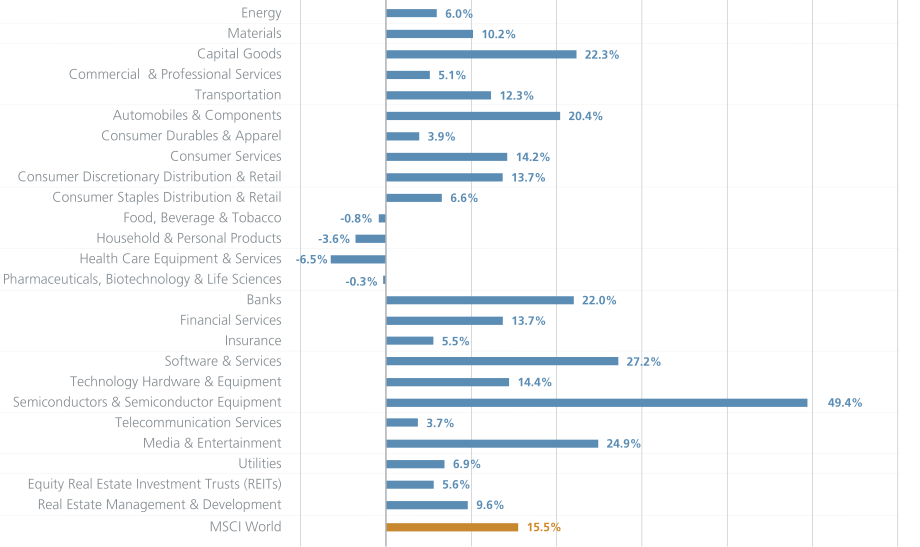
The recovery since April 8 has been led by cyclicals. Semiconductors, financials, autos and capital goods took the lead. The Mag 7 index also reversed, rising almost 40% in local terms.
Volatility goes both ways … is it worth the risk?
Looking at selected peers, we observed that the tremendous spike in volatility around Liberation Day affected relative performance significantly. Most of their active funds show typical return patterns. With the clear caveat that these are not showing representative results, it is highly visible that there was a massive spike in volatility of relative returns around Liberation Day.
Figure 5: Relative returns to MSCI World for Quoniam Enhanced Index and selected global equity funds

Unlike in the broad equity market, most active fund managers’ performance did not fully recover from the second-quarter downturn. As we have demonstrated, this is unsurprisingly related to the change in leaders and laggers from a style and a sector perspective. As traditional active funds tend to implement concentrated portfolios and significant style tilts, they would have had to rebalance the entire portfolio to keep up.
Value would have to have been switched to growth and telecoms and a staples overweight replaced by technology and growth stocks. This was rarely the case and such thorough rebalancing would probably have required a crystal ball and outstanding boldness. As the charts and data have shown, timing is always crucial. Changing exposure at the end of March would have been too soon and the beginning of May would have been too late to outperform the broad equity market.
Looking at just a handful of funds, we can see a pattern that relative performance was negatively affected by the sell-off in most cases. The ‘usual’ pattern is underperformance during the choppy volatile sell-offs in the first months, with some but almost never a complete recovery in the second quarter.
Discretion vs. diversification: Active managers struggle as systematic approaches shine
The most probable cause of this return behaviour is the dramatic shift in investor sentiment and the behavioural biases of fund managers. Given the performance in 2024, most active mangers maintained growth exposure to continue participating in the market rally. Consequently, these strategies were affected by the downtrend and the respective underperformance of the factor, e.g. MSCI World Growth -5.5%.
As we have shown, the positioning itself should not have been a problem, given that the growth style rebounded by 6.5% from April 8 until the end of June. However, it is likely that at least some if not many managers were misled, reacting to the new market paradigm of reciprocal tariffs and their negative consequences on profitability and revenue of the global economy. As these strategy shifts were implemented shortly after the sell-off, the upside participation is limited, in other words, the fund underperforms the market.
The chart above might at first appear subjective, given the few selected funds in our chart. We therefore dug deeper to see if it is representative for a broader peer group year-to-date.
We screened Bloomberg for global equity funds with at least a 95% equity allocation, available and domiciled in Europe, and found roughly 2,000 mutuals funds. Of these, approximately 1,500 offered relative performance data against their benchmark. Only 38% (565) out of these global equity funds achieved a positive relative return for the year-to-date period, while the remaining 62% (935) underperformed their benchmark.
In contrast, a diversified quant-based portfolio spanning 300 stocks performed better during the extreme swings of Q2. The sharp style and sector reversals were absorbed more smoothly thanks to the portfolio’s broad-based exposure. For instance, although quality and growth styles underperformed during the drawdown, both rebounded by 6.5% or more after April 8. A diversified portfolio captured these shifts automatically, without the need for discretionary rebalancing.
Conclusion
Clearly 2025 has been a challenging environment for active managers (again). While some achieved successful positioning, almost all suffered relative performance drawdown around the tumultuous Liberation Day.
In this environment, a risk-controlled investment style with a proven systematic investment process can offer the most attractive risk-return characteristics, avoiding the short-term disruptions and hiccups caused by external and political shocks.