Market commentary bonds: A new macro world
The global political and economic landscape is on the verge of a profound change, having a significant impact on both, the US and Europe. In his market commentary, Dr Harald Henke, Head of Fixed Income, discusses the influence of rising interest rates, inflation and geopolitical tensions on your portfolio.


Dr. Harald Henke
Principal Investment Strategist Fixed Income
In our last quarterly article, we discussed the uncertainty surrounding political developments under the new US administration. After three months, we can see that the changes are more fundamental than the market had expected. This has already had an unforeseeable impact on political decisions in Germany and Europe. The movements on the markets were correspondingly far-reaching.
Political environment
The new US administration has many issues to address, such as the geopolitical environment (particularly in Eastern Europe and the Middle East), excessive government spending, immigration and the competitiveness of the US economy. While many initiatives have been launched, there is still a lack of robust results in many areas that would allow a more in-depth assessment. Nevertheless, some conclusions can already be drawn:
- Immigration: While this highly politicised topic continues to be the subject of controversial debate and measures to strengthen the southern border of the USA have been implemented, there have been no mass deportations or a dramatic tightening of the labour market situation. This means that the labour market situation in the USA is less critical than analysts feared in a worst-case scenario.
- Competitiveness of the US economy: Here, too, there have been isolated initial measures such as easing restrictions on oil production and individual tightening measures, particularly for Chinese competitors. The issue of tariffs is still being worked out. While President Trump has not held back with tariff threats (in the expectation of receiving counter-offers that represent an improvement in the relative competitiveness of US companies, as is Trump’s style), it is not yet clear whether the tactic will be successful and the world will enter a regime of lower tariffs at the end of the negotiations, or whether the sides will harden and we will end up in an environment of higher tariffs for all. The implications for the global economy will very much depend on this.
- Public finances: This is definitely where the most progress has been made. While the Department of Government Efficiency is going through spending and has closed numerous government agencies and cut jobs, the impression has been created that for the first time in a long time the completely out-of-control US national debt is being taken seriously. President Trump’s proposal to halve the budget of the US Department of Defence over the next few years is historically unprecedented. It remains to be seen how these initiatives will translate into reality or whether much of it will eventually come to nothing.
- Geopolitics: While the initial impression has been that the administration is trying to end the world’s major conflicts, the US is in danger of reaching an impasse, particularly in the Middle East, with its tactic of maximum pressure and ending up at war with Iran, with catastrophic consequences for all potential belligerents, the region and the global economy. While the negotiations in Ukraine give reason for cautious optimism about the medium-term outcome of the war, a strong division has emerged between the US and Europe, which has led to a realignment of defence strategy in Europe. While details are still lacking, this reorientation is likely to lead to a more independent European policy.
Impact on the USA and Europe
After a good two months under the new US administration, the effects are immense and are probably not yet fully understood, especially in Europe.
The EU and Germany are discussing hundreds of billions of euros in defence and infrastructure spending. In addition, the debt brake in Germany has been relaxed and decades of conservative fiscal policy have been abandoned. This has a profound impact on the long-term inflation and interest rate levels in Europe. Defence spending in particular creates demand that is not matched by consumer goods and assets, which leads to higher inflation rates. This in turn will drive up interest rates. While government spending is included in the GDP calculation to the extent of its expenditure, the longer-term effects of debt and debt dynamics are a cause for concern. Not only will the majority of spending be debt-financed, but the enforcement of debt limits such as the Maastricht criteria at European level will not be possible under this precedent. In the longer term, Europe faces the threat of a spiral of excessive debt and inflation.
In the US, the medium-term dynamics are not yet foreseeable and depend on how the developments discussed above materialise. A kind of adjustment recession is relatively likely, in which the cuts to the national budget, which are likely to strengthen growth in the medium term, will depress sentiment and overall economic demand in the short term. The supposedly strong US labour market has also recently been primarily a government phenomenon. A large share of the jobs created in 2024 according to the household survey were in the government sector, a development that cannot be financed in the long term.
Interest rate trends and inflation expectations
The market developments were correspondingly clear. German interest rates shot up after the fiscal plans were announced and the yield curve steepened considerably.
Figure 1: Yield curve in Germany

As can be seen from the chart, interest rates across the entire curve – except for the very short end – increased significantly over Q1. Ten-year interest rates rose by 37 basis points from 2.37% to 2.74%. The spread between two-year and ten-year rates rose from 29 to 69 basis points in line with expectations of higher inflation. Interest rates fell significantly at the short end, suggesting that the market sees further rate cuts in the eurozone due to global growth concerns.
In the USA, on the other hand, a different interest rate dynamic was observed.
Figure 2: Interest rate trend in the USA

Interest rates in the US have completely decoupled from European interest rates and have fallen significantly over the quarter. The trend from inversion to steepening of the curve has also continued, even if this movement has recently stalled somewhat.
The Fed has not made any changes to its expectations either. Members’ expectations, expressed in the Fed’s dot plots, were unchanged in March compared to December. Although the Fed emphasised uncertainty regarding future developments, it took a more relaxed view of current political developments than expected.
Leading economic indicators in the USA, such as consumer confidence, have recently deteriorated in line with the expected economic slowdown. In Germany, on the other hand, expectations of higher inflation rates and interest rates were clearly reflected in the ZEW sentiment indicators.
Figure 3: Sentiment indicators in Germany – inflation and interest rates
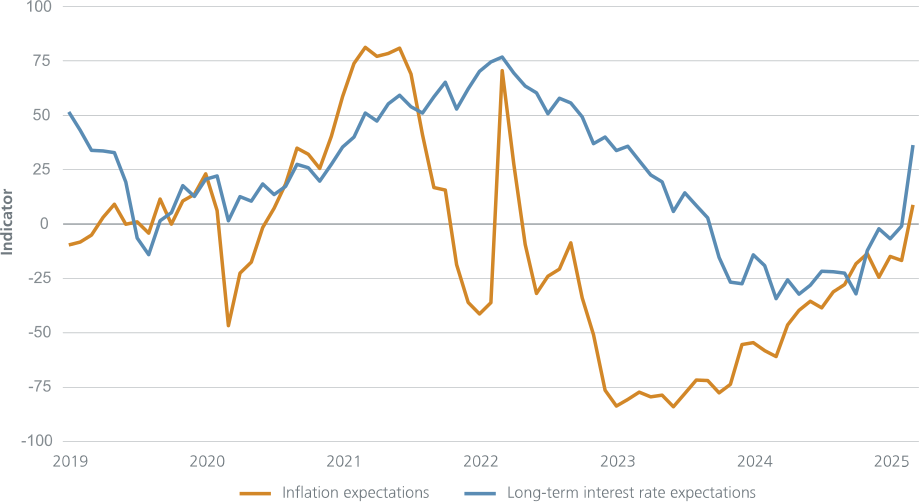
The March figures from the ZEW saw an increase in the proportion of financial market analysts who take a more positive view of economic development in Germany than before. As can be seen in Figure 3, there was a big leap in terms of higher interest and inflation rates. While the balance of those who are worried about inflation is still close to zero, a clear majority see higher interest rates as the most likely scenario. Accordingly, interest rate developments in the eurozone are likely to be the focus of attention over the next few quarters. Individual estimates are already predicting an equalisation of the ten-year interest rate level between Germany and the USA.
Credit spreads
Figure 4: Credit spreads in euro and USD
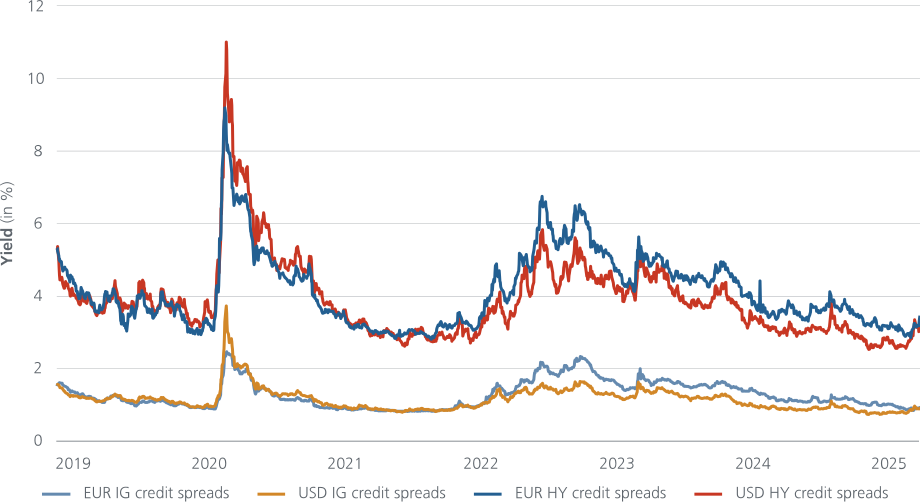
There were also notable developments on the spread side. After three years, USD spreads in both the investment grade (IG) and high yield (HY) segments have climbed back above the level of euro spreads – where they have historically always been found due to the longer average residual term and somewhat weaker credit rating in the USD segment. With the significantly weaker growth momentum in Europe since 2022 and the continent’s geopolitical risk premium, this trend had reversed1, and credit spreads in Europe were at a higher level than US spreads.
While defence companies and those benefiting from government projects were clear winners in March, interest rate-sensitive sectors such as real estate companies lagged the market. The potential for stock selection is likely to remain high in the coming quarters: Companies that mainly sell in Europe and where the new government spending tends to arrive first are likely to be among the winners, while export companies in interest-sensitive sectors will generally have to overcome headwinds.
Conclusion
The world is in upheaval and the political landscape in Europe and the USA is also undergoing fundamental changes. While the details are still unclear, the trend towards higher interest and inflation rates and – at least in the short term – higher growth rates in Europe is obvious. It remains to be seen how inflation in Europe and weakening growth momentum in the USA will influence each other. In the current market environment, investors should be aware of the risks and utilise the potential of individual stock selection.
- A detailed analysis of the reasons can be found in our article “Why have EUR credit spreads been higher than USD credit spreads since 2022?” ↩︎