Is the AI bubble starting to impact corporate bond markets?
Meta and Alphabet/Google recently entered the corporate bond market with two jumbo issuances. Will the projected AI capex of the large US tech companies make them index heavyweights in corporate bond benchmarks? Will the increase in debt be accompanied by rising company spreads? Do investors need to adjust their benchmark choice or investment universe?

Dr. Harald Henke
Principal Investment Strategist Fixed Income
Key takeaways
-
AI investment, not a bond boom: Despite heavy spending, the MAG7 remain a minor force in the investment grade bond market.
-
Strong balance sheets, ample leeway: Top-tier ratings provide flexibility for further growth.
-
Balanced valuation: Spreads indicate that markets view risks and opportunities as evenly matched.
AI investments and corporate bonds
The current bubble in AI-related stocks, best represented by the high index share and lofty valuations of the so-called ‘Magnificent 7’ (‘MAG7’ comprising Alphabet/Google, Amazon, Apple, Meta, Microsoft, Nvidia, and Tesla), is slowly visible in the corporate bond market, too. With its recent jumbo issuances, Google and Meta have significantly increased their weights in standard global investment grade (IG) credit benchmarks. Moreover, AI-related capex plans of some of the big tech companies suggest that more bonds may be issued to the market soon.
While Google is investing in data centres, servers, AI networks and its cloud infrastructure, Meta is planning to invest the funds it has raised in GPU fleets and additional data centres. Microsoft also plans AI-related capex expenditures of 80 billion USD, while Amazon’s investments in this area may reach 100 billion USD. And while the big tech companies can stem much of this investment using free cash flows, companies are likely to finance a part of these expenditures by issuing new bonds.
We examine the current outstanding bonds (including the most recent issuance by Alphabet) to determine the weight of the MAG7 companies in the traditional global IG credit benchmarks, and to compare the outstanding bond volumes with the companies’ market capitalisation.
Outstanding bond volumes and benchmark weights
Table 1: Market capitalisation and bonds outstanding of the MAG7
| MAG7 Company | Current Market Cap (bn USD) | Bond Nominal Outstanding (bn USD) | Bonds / Equity | Global IG Credit Weight |
|---|---|---|---|---|
| Alphabet/Google | 3,463.93 | 44.25 | 1.3 % | 0.32 % |
| Amazon | 2,610.55 | 50.25 | 1.9 % | 0.33 % |
| Apple | 4,040.89 | 76.13 | 1.9 % | 0.50 % |
| Meta Platforms | 1,535.36 | 58.88 | 3.8 % | 0.43 % |
| Microsoft | 3,798.99 | 40.16 | 1.1 % | 0.24 % |
| Nvidia | 4,709.34 | 7.50 | 0.2 % | 0.05 % |
| Tesla | 1,432.10 | 0.00 | 0.0 % | 0.00 % |
As can be seen from the table, the amount of outstanding bonds held by the MAG7 companies pales in comparison to their market capitalisation. The ratio of bonds to market capitalisation ranges from 0% for Tesla (which has no outstanding bonds) to 3.8% for Meta following the latest large-scale issuance. Even if one were to assume that the market value is inflated and could fall by 50%, the volume of bonds would still be small relative to the companies’ overall market value.
Overall, the companies have a little over 277 billion USD of outstanding bond nominal value. This equates to 1.87% of the global IG corporate bond market index. Apple has the largest weighting at 0.5% of the index, whereas Nvidia, currently the world’s largest company, adds only 0.05%. The MAG7 are currently far from dominating bond indices in the same way that they dominate equity indices.
How may weights change over the next years?
The question, however, remains whether upcoming bond issues could meaningfully change the overall contribution of the MAG7 to corporate bond indices. A quick numerical example shows that it is very unlikely that corporate bonds become equity-like in terms of tech dominance in the market.
Lets’s assume that Microsoft and Amazon finance their 180 billion capex plans fully with corporate bond issues bringing the issued volume of the MAG7 to roughly 450 billion USD. If we generously assume that, over the next three years, these companies will double their outstanding bonds and roll maturing issues into new bonds due to large unforeseen investment needs, we end up with a volume of 900 billion USD in outstanding bonds – a very unlikely extreme scenario.
Assuming the overall global credit index volume grows by almost 6% per year, as it has done over the last five years, the MAG7’s overall weight would reach just 5.65% of the overall index. This equates to 0.84% per issuer, or 0.91% per issuer if we assume that Tesla continues to avoid the bond market. This would make them larger names in the index, but they would still be far from dominant, even in such an unrealistic extreme scenario.
Rating picture: Balance sheets and market positions are some of the best in the world
Table 2: Rating overview of the MAG7 issuers
| MAG7 Company | Median Rating |
|---|---|
| Alphabet/Google | AA |
| Amazon | AA |
| Apple | AA+ |
| Meta Platforms | AA- |
| Microsoft | AAA |
| Nvidia | AA- |
| Tesla | BBB- |
Table 2 illustrates how much leeway the MAG7 companies have to increase leverage to finance their investments and still have investment grade ratings. As can be seen, the median rating of the ratings of the three big rating agencies Moody’s, Standard & Poor’s, and Fitch is in the AA or even AAA area for six out of seven companies. Only Tesla is at the verge of high yield but is not an issuer in the bond market.
The rating agencies take into account not only the strong balance sheets of these companies, but also their growth prospects and market positions. The extremely strong ratings are an indicator of the stability of these companies and their current business models. As ratings usually do not change rapidly, this picture is unlikely to meaningfully change in the short-term.
Are MAG7 bonds expensive?
Are these business models rewarded with spread discounts or does the prospect of more bonds being issued in the future already weigh on valuations? We illustrate this with the Google credit curve vs. its rating peers in the euro credit space.
Figure 1: Alphabet/Google bonds vs. the euro IG AA credit curve
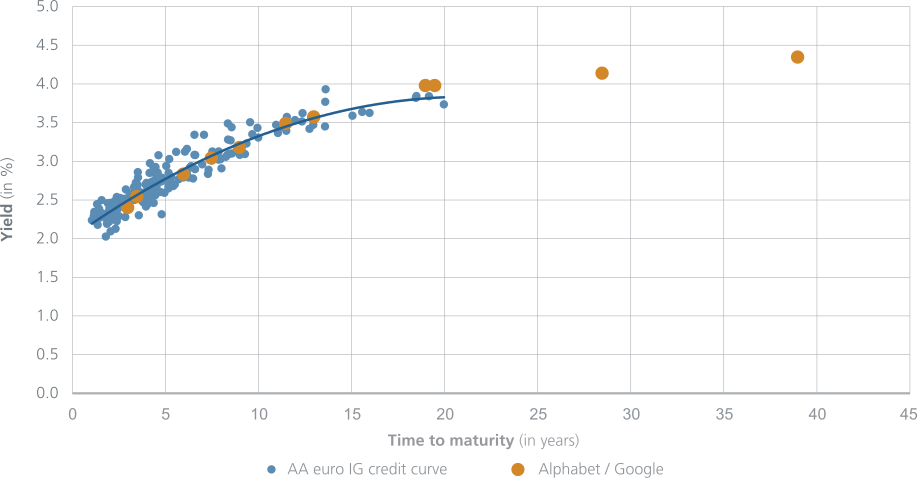
As can be seen in the euro IG AA credit space, Google’s bonds are very close to the average for short and medium maturities and somewhat above the curve for longer maturities. There are no signs of a spread discount relative to the peer group. And while we cannot show all curves of the MAG7 for all major currency areas, the picture looks very similar in most of the cases. Markets seem to currently have a very balanced assessment of the chances and risks associated with the bonds of the large US tech companies.
That does not mean that there are no risks in AI-related bond investments. Outside the MAG7, Oracle has made headlines for investing 25 billion USD over three years in AI-related projects. This led the CDS spread of Oracle to widen forcefully over the last two months as displayed in figure 2.
Figure 2: Oracle CDS spread

As can be seen, over the course of the last two months Oracle CDS spreads increased two-and-a-half-fold reflecting increasing investor worries about the large investments of the BBB rated company. But the large players in the market are in a different situation, and while their spreads may also rise in connection with the upcoming investments, their situation points to a more nuanced market reaction.
Conclusion
Although concentration in the US equity market is a frequently discussed topic, the same phenomenon is not currently experienced in credit markets. Therefore, it is unsurprising that market participants are wondering whether the ongoing and expected issuance of bonds to finance substantial AI-related investments could lead to the corporate bond market becoming more similar to the equity market.
We show that the current weight of the MAG7 in global IG credit indices is small, and it is miniscule compared to the market value of their equity. Moreover, strong balance sheets, strongly growing businesses and dominating market positions lead to very strong credit ratings. This gives the MAG7 companies flexibility to increase leverage without overwhelming credit markets.
We are not arguing that the AI-related growth these companies hope for will not materialise and that valuations will drop significantly in the future. We argue that the overall effect of the MAG7 will be much smaller in credit markets compared to equities even in an extreme scenario with an explosion in new bonds over the next few years. And while there are many worries in bond markets, from lacklustre growth and tariff wars to deteriorating government finances and an uncertain inflation outlook, the MAG7 are currently not high on the list.