USD IG Credit after the US election – factor approaches are well positioned
Donald Trump is the 47th President of the USA. With a clearer than expected result, the Republican candidate defeated his Democratic rival Kamala Harris and will probably be able to govern uncontested due to the majority in Congress. What can we expect for the USD investment grade (IG) credit asset class as a result and how will factor approaches deal with the expected change in policy?


Dr. Harald Henke
Principal Investment Strategist Fixed Income
The long-awaited US presidential election is over. Contrary to the fears of some observers, the announcement of the result was not a long, drawn-out process, but the elections ended with a clear result. Donald Trump not only won the majority of electoral votes, including victories in all so-called “swing states”, but also an absolute majority of all votes cast.
At the same time, the Republicans were able to capture some of the Senate seats up for election from Democratic incumbents and achieved a majority in the Senate. As the completely newly elected House of Representatives is also likely to be in Republican hands, the new US government will be able to govern from January without having to compromise with the Democrats.
The challenge in asset management
While the political arena is still immersed in analysing the causes and political implications of the election result, the capital market is already looking ahead. Asset managers are faced with the task of finding answers to many more questions and positioning their portfolios accordingly. The complexity of the task becomes clear when one looks at the following extract of the relevant questions:
- What policies will the new administration pursue and how will this affect the global economy and individual sectors and companies? Will Trump plan massive budget deficits and drive up US interest rates, as he did in his first term and as the Democrats did under Biden? Or, contrary to expectations, will he take up the fight against inflation, which is making everyday life more difficult for many people? How will the Federal Reserve react? And what will the bond market do if new debt continues to rise?
- Which sectors will benefit? Will environmental regulations that have restricted domestic oil and gas production be lifted? Will there be changes to the healthcare system with an impact on the profits of many private providers? And what role will the technology sector play under President Trump, who is openly in favour of cryptocurrencies and wants to make Elon Musk part of his administration?
- What will the relationship with the rest of the world be like? How long will Trump’s realisation expressed during the election campaign that sanctions only weaken the US dollar last? Or will he return to the policy of Biden and his first term in office of imposing sanctions on US industry competitors and geopolitical rivals? Will he make good on his threat to use tariffs as political leverage or will the famous phrase that nowhere is there so much lying as before the election, during the war and after the hunt apply here too?
It is clear from the questions posed that many answers are unclear and that wrong conclusions regarding some of these questions are to be expected. Successfully navigating the current environment will be a key prerequisite for asset managers to beat the market average and deliver added value for their clients.
How quantitative strategies work
Fundamental asset managers develop opinions and adjust them as the formation of a government progresses. The aim of quantitative approaches, on the other hand, is to collect factor premia that can be earned independently of the general political environment. A look at history shows that US presidential elections have not led to structural changes in factor returns and factor volatilities in the past.
Figure 1: Historical factor returns and volatilities

As can be seen from Figure 1, the returns on systematic factors in the election months were not systematically different from the months before and after – despite surprises such as the election result in 2016. Nor did the volatility of these factor returns increase around the election. Rather, the level of volatility is influenced by other events such as the global financial crisis or the Covid pandemic.
In contrast to fundamental managers, who rely on subjective assessments, quantitative credit managers use a range of systematic factors that capture changes in the market. These include, but are not limited to:
- Stock price momentum – systematic credit managers use information from share price movements to forecast the development of bond prices. The rationale of this approach is the empirical observation that for the majority of all companies, information is reflected faster and more completely in the share price than in the bond price. The latter is often slower to react, so that a look at the share performance allows conclusions to be drawn about future bond performance.
- Value – quantitative approaches attempt to systematically evaluate which bonds are over- and undervalued across the entire universe. A wide range of information is taken into account to determine fair value – from long-term balance sheet ratios to shorter-term stock ratios and analyst estimates. This information also reflects changes arising from the political environment. Empirical evidence shows that markets correct these mispricings over the medium term.
The energy sector in the USA is a good example of this. Following Trump’s election victory and statements about supporting domestic oil and gas production, shares in US oil producers rose sharply on the following day. Credit spreads in the US energy sector tightened by 4.7 basis points, while the market fell by 4 basis points. The average momentum signal of US companies in the sector rose by 0.9 percentage points on a scale of 0% for the worst to 100% for the best forecast within one day, which represents a huge one-day movement. The value signal, on the other hand, deteriorated by 0.5 percentage points, as the decline in spreads was not directly accompanied by an increase in fundamental indicators. The value signal compares the market spread with a fair spread. Here, the market spread reacted faster, which led to a decline in the value signal.
Figure 2: Spread and forecast changes for US energy companies
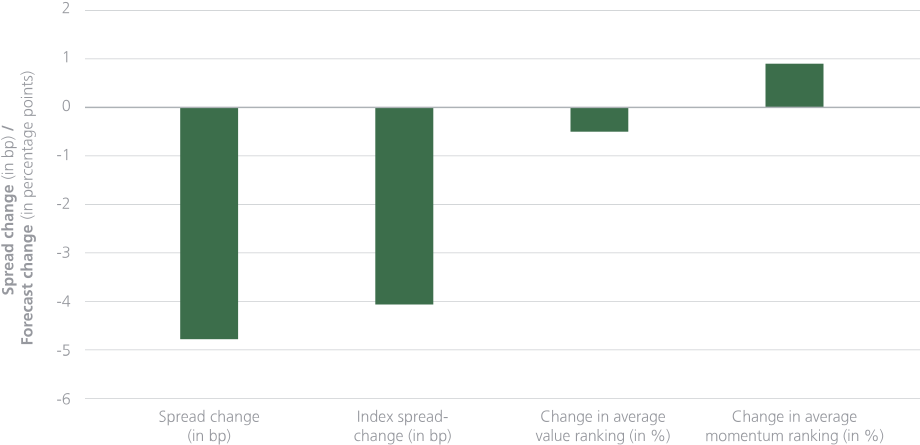
If it becomes clear over time that the positive sentiment will result in better equity risk, higher analyst estimates and higher company earnings, the value factor will also rise. If the market’s assessment turns out to be wrong, equity momentum will weaken and push the factor signal down. In both cases, the factor forecast recognises the actual development of the companies.
In general, systematic approaches are good at picking up longer-term trends, as is often the case within a political cycle. It is unlikely that certain industrial policy objectives and measures will be changed several times within a government cycle. As the development, implementation and impact of political measures take time, four-year election cycles are often characterised by stable trends. This favours factor approaches.
US dollar IG credits entered a new phase of the political cycle on 6 November 2024. Only time will tell which regions, sectors and companies will benefit and which will suffer. What we can already say today is that systematic factor approaches are well positioned to successfully master this change in the political landscape.


