Factor investing in emerging markets: Performance ahead of the pack
Factor investing in equities has proven effective by systematically identifying and targeting return drivers that are different from the broader market. But, how do regions vary? In this article, portfolio manager Johannes Lins, CFA, explores the differences in factor performance between three common investment regions and looks at why emerging market factor portfolios pull ahead of the pack.


Johannes Lins, CFA
Portfolio Manager Equities
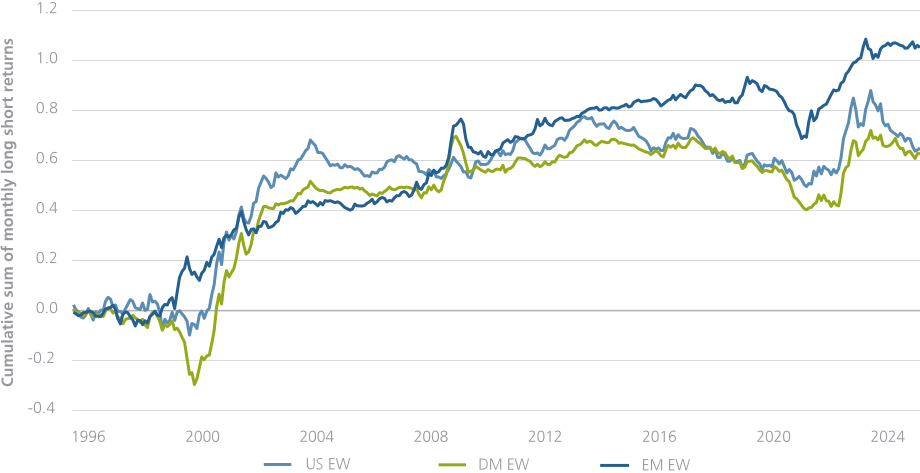
Using historical factor data was our starting point for investigating regional differences in factor performance, looking at the three most common allocation regions. We find that in emerging markets, companies with significant exposure to these factors have outperformed relative to those in the US and broader developed markets.
Structural reasons for superior performance
What are the possible reasons for this observation? While behavioural biases play a role in emerging markets, we believe that structural aspects, such as the persistence of momentum, the resilience of value, or volatility and compounding, better explain the strong performance of factor strategies in these markets.
Figure 1: Emerging markets ahead of the pack: Cumulative performance of equally weighted factor combinations
Market inefficiencies and a heterogeneous universe
Emerging markets often display inefficiencies due to underdeveloped financial systems, lower liquidity, and inconsistent regulatory frameworks. The sheer size of the EM universe, with over 3,000 stocks across 25 countries, further complicates traditional fundamental analysis. This diverse and fragmented environment, spanning multiple time zones and less integrated economic areas, makes it difficult for analysts to respond quickly. Opportunities for systematic factor-based strategies to outperform may arise from such circumstances.
- Value: Unlike in developed markets, where value strategies suffered during the “quant winter”, value in emerging markets has shown more resilience. Stocks may be mispriced due to lower investor coverage and less comprehensive security analysis, allowing value strategies to exploit inefficiencies. Given the limited number of analysts, in particular for mid- and small-caps, these mispricings tend to persist for longer.
- Momentum: Continued high exposure to momentum, which has performed particularly well in emerging markets, has helped compared to other regions. In markets where information flows are slower and sentiment shifts take longer, momentum strategies are better positioned to capture extended trends. However, smart implementation is crucial in these markets due to liquidity and cost concerns. A high level of expertise in trading EM equities provides an edge in navigating these challenges.
The charts below show the stronger performance of both the value and momentum factors in emerging markets.
Figure 2: Both value and momentum show strength in emerging markets

Higher return potential from risk premiums
Emerging market equities often carry higher risk premiums than their developed market counterparts. Factor strategies like size (small-cap stocks) and low volatility are well positioned to exploit these premiums:
- Small-caps in emerging markets tend to be under-researched, and investors demand a significant premium for their higher perceived risk.
- Low-volatility strategies capitalise on inherently high volatility of emerging markets by focusing on stocks with less price variation. These strategies benefit from compounding effects, which are particularly pronounced in more volatile markets. By meaningfully reducing risk, low risk strategies can benefit from volatility more effectively in emerging markets.
Diversification
While it would be tempting to attribute the stronger risk-adjusted performance of a multi-factor portfolio in emerging markets to better diversification opportunities across factors in that market, the evidence suggests that the diversification benefits are broadly similar in emerging markets and developed markets. In particular, we find that the difference between the realised risk of an equally weighted multi-factor portfolio and the theoretical value expected when assuming zero correlation among factors, is similar in emerging and developed markets. The superior risk-adjusted performance is a result of the typically lower risk of Kenneth French’s factors in emerging markets over the period of our analysis together with their stronger returns, especially for value and momentum.
Conclusion
Factor investing works in both emerging and developed markets, however it has performed particularly well in emerging markets recently. The higher volatility, risk premiums, and structural inefficiencies of emerging markets may provide fertile ground for factors such as momentum and value to outperform. Expertise in factor forecasting and smart implementation through a systematic approach, particularly in managing costs and liquidity as well as offering fast processing of new information, can help capture the potential of emerging markets.
In light of these observations, we believe factor investing in emerging markets will remain a powerful tool for capturing higher returns and mitigating risk, despite the inherent challenges of these markets.


