Market commentary equities: The great reversal in the first quarter of 2025
In our market commentary, Mark Frielinghaus, CFA, Portfolio Manager Equities, delves into the remarkable shift in investment styles witnessed during the first quarter of 2025. We explore the dynamics of key performance drivers, including low volatility, value, and momentum, unraveling how these elements have evolved and influenced market trends in this transformative period.


Mark Frielinghaus, CFA
Principal Investment Strategist Equities
In the first quarter of 2025, equity markets experienced a tremendous increase in volatility and a shift in sentiment, especially in terms of factor volatility. While 2024 was again dominated by US exceptionalism, the artificial intelligence trend and the continued rise of the Magnificent 7 stocks, 2025 is showing a different pattern so far.
Figure 1: Development of international equity markets
Panel A:

Panel B:

Panel C:
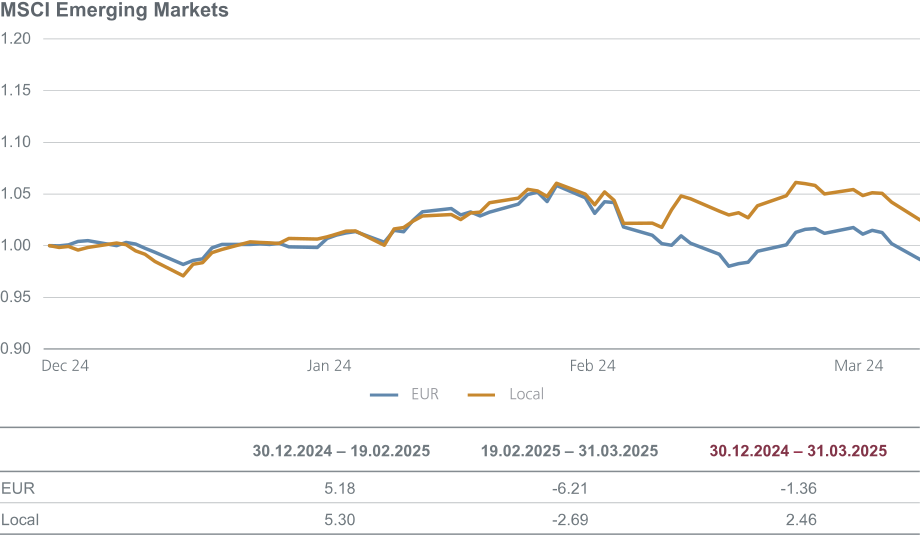
Driven by geopolitical risks in general and President Trump’s increasingly erratic tariff policy in particular, equity markets were caught in a risk-off mood around mid-February. All the warning signs that have so far failed to slow the equity rally, such as the historically high valuation of the US stock market, sticky inflation that will be fuelled by the full-blown trade war between the US and the rest of the world, and low-cost competition from China even in the AI space, have started to sour investor sentiment.
The market downturn was significant but remains well contained yet. While US equity markets corrected roughly 10% from peak to trough, the European and EM counterparts outperformed their US peers. Only trading sideways while US stocks fell, European indices remain around 7% in positive territory and the EM 2.5% in the green (both in local currency terms). The US losses year-to-date range between 4 and 10% for the S&P and the NASDAQ.
Figure 2: Development of the markets by MSCI factor categories
Panel A:

Panel B:
Panel C:

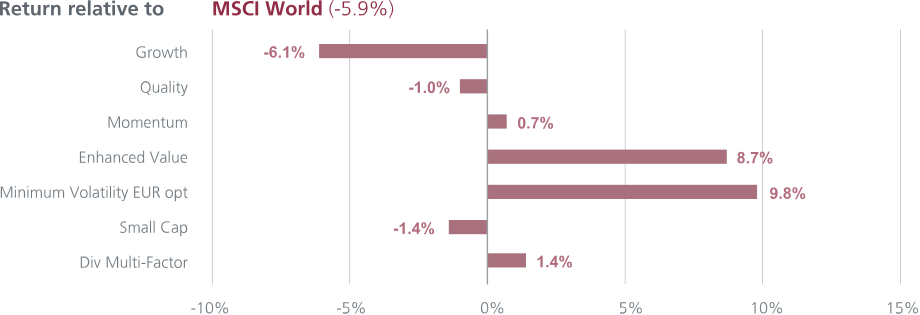
What all measures of factor returns confirm is a significant factor breakdown in the momentum/growth style of investing and a favourable upturn for defensive.

Mark Frielinghaus, CFA
Portfolio Manager Equities
Looking at factor returns, the shift in leadership due to the turnaround is clear. Starting with the MSCI factor indices, we see strong outperformance by value and low-volatility styles even for the year-to-date period, while both indices have struggled to keep pace with market returns in recent years. The downturn in growth completes the picture, creating a gap of around 15% between growth (aggressive) and low volatility (defensive) investing.
We can examine this in more detail by splitting the year-to-date period on 19 February, when US markets peaked for 2025. The shift was triggered by commentary on the US administration’s planned tariff implementation and border enforcement, while fiscal stimulus policies appeared to be a lower priority.
Factor analysis – upturn period Jan. 1 – Feb. 19 vs. downturn period Feb. 20 – Mar. 31
| Upturn 2025 | Downturn 2025 | |
|---|---|---|
| Low volatility | -3.44% | 21,33% |
| Dividend yield | -1.44% | 10,21% |
| Size | -2,11% | 8,71% |
| Momentum | -0,49% | 9,00% |
| Value | 3,94% | -5,83% |
| Growth | 3,14% | -8,87% |
The table above uses a long/short definition for each factor and uses the US all-cap equity universe. As can be seen, every major investment style reversed after the initial sentiment shift in the equity market. Most notable was the turnaround in growth, which went from a return of +3% to a loss of -10%. In addition, the defensive style was clearly in the ascendant, posting excessive gains in a short space of time. While the low volatility style turned an underperformance of -3% into a whopping 27% outperformance in just 4 weeks, the dividend style also recovered from negative returns to a double-digit positive result based on a long-short methodology.
The absolute change in returns may vary depending on the methodology used to calculate factor returns. However, what all measures of factor returns confirm is a significant factor breakdown in the momentum/growth style of investing and a favourable upturn for defensive investing , reflected in the low volatility and value factors.
Before the reversal in factor returns, the growth/momentum style was very crowded. Now the positioning has changed dramatically with low volatility crowding rising sharply, which can also be seen in the movement of the relative P/E spread to the market. Prior to the market correction on 19 February, the estimated forward P/E for the S&P 500 was 27.7, compared with a P/E of 20.5 for the S&P Low Volatility Index. While the low volatility P/E remained range-bound around 20, the S&P P/E briefly dipped below 19 in mid-March.
Conclusion: short-term hiccup or full-blown correction?
While these market and factor dislocations have been severe over the past 6 weeks, it remains to be seen whether the hiccup in the US equity market will turn into a full-blown correction. The ongoing political tensions surrounding the war in Ukraine and perhaps even more so the further escalation of the trade war that the US seems to be unleashing worldwide will certainly continue to keep the markets in suspense.1
- As of end of March 2025 – After the Liberation Day Speech, developments have intensified. ↩︎