Corporate bonds 2026: Yields, risks and realistic scenarios
The year 2025 was characterised by rising interest rates and declining credit spreads. Based on current spread and yield levels, what returns can be expected from corporate bonds in 2026?

Dr. Harald Henke
Principal Investment Strategist Fixed Income
Key takeaways
-
Solid starting point: Corporate bonds enter 2026 with running yields of around 3% and additional roll-down returns.
-
Attractive total yields: Despite low spreads, yields are at or above their historical average.
-
Built-in income buffer: Running yield and roll-down cushion moderate increases in yields.
Starting point: Yields, roll-down and market dynamics
At the start of 2026, corporate bonds are yielding just over 3%. The current yield on the ICE US Corporate Master Index amounted to 3.04% (after currency hedging into euros), while the same index for euro-denominated investment grade (IG) corporate bonds stood at 3.2%. However, the actual return for 2026 is determined by the sum of this current yield, roll-down returns and additional returns resulting from changes in interest rates and spreads. The following sections examine these components in more detail.
Roll-down as return driver: when time turns into profit
The remaining time to maturity of bonds shortens over time. A bond with a remaining maturity of three years today will have a maturity of two years in one year’s time. If the yield curve is rising – meaning that longer-dated bonds from the same issuer offer higher yields than shorter-dated bonds – a shortening of the remaining maturity leads to a decline in yield (all else being equal). This is accompanied by an increase in the bond price and thus a return, known as the roll-down return.
The steeper the yield curves, the higher the roll-down return. If the curve is completely flat, the roll-down return is zero. In case of an inverted curve, where yields decline as maturity increases, the roll-down return is negative (so-called “roll-up”).
Figure 1 shows the steepness of the German and US yield curves, measured by the difference between ten-year and two-year yields over time.
Figure 1: Yield curve steepness over time
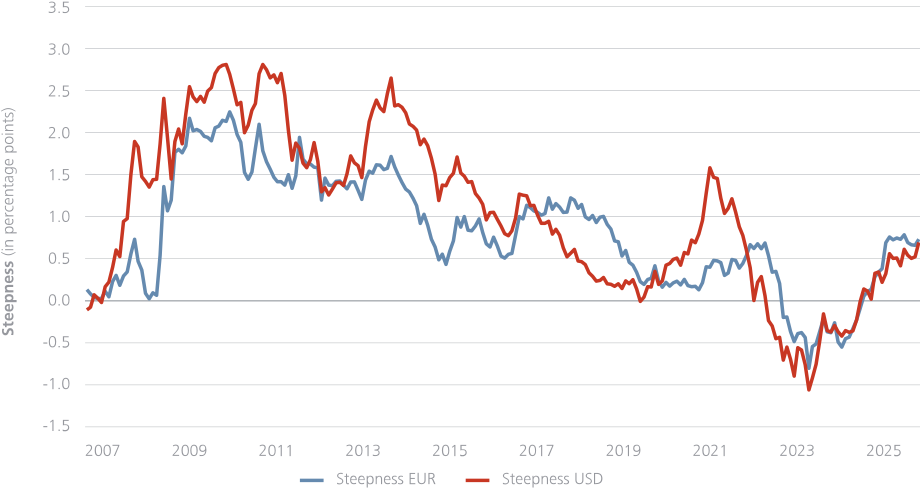
Figure 1 illustrates that yield curves in both Europe and the United States have regained a degree of steepness after several years of inversion. In both currency areas, the difference between ten-year and two-year yields stands at between 70 and 80 basis points. In Europe, this represents the highest level since the end of 2018, while in the US such steepness was last observed in early 2017, aside from a brief period at the end of 2020 / beginning of 2021.
Since not only the risk-free yield curve but also the average spread curve of corporate bond issuers is rising, the expected roll-down return results from the sum of interest rate roll-down and spread roll-down. Figure 2 illustrates the resulting expected return for one year.
Figure 2: Roll-down return by maturity

As can be seen in Figure 2, curve steepness and the resulting roll-down returns are highest in the maturity range between seven and ten years. In this segment, additional returns of more than 70 basis points per annum can be expected for both euro and USD IG credit. For both shorter and longer maturities, the roll-down returns decline, but remain positive across the entire curve. Euro IG values are consistently higher than those of USD IG. On average, a roll-down return of around 50 basis points can be expected across the entire universe.
Tight spreads – but attractive overall yields
One concern sometimes raised regarding corporate bonds in the current market environment is the historically low level of spreads, as shown in Figure 3.
Figure 3: Monthly spread levels in historical perspective
Left: Euro IG Credit and right: USD IG Credit

In euro IG, spreads are historically at the 20th percentile, meaning that in 20% of all month-ends spreads were lower than today, and in 80% of cases higher. For USD IG, spreads are at their fourth-lowest monthly level since 2000. As discussed elsewhere, this level does not necessarily imply that credit spreads are unattractive.
However, even more relevant for investors than the spread level is the total yield of corporate bonds, which consists of the base interest rate and the credit spread. In this context, the comparison shows historical average values.
Figure 4: Corporate bond yields in historical perspective
Left: Euro IG Credit and right: USD IG Credit

The euro credit yield of 3.23% as of 31 December 2025 is at the 46th percentile historically, while the (unhedged) US dollar yield of 4.81% is at the 59th percentile and thus above its historical average. From a yield perspective, corporate bonds are historically attractive.
When spreads rise and rates fall: The overall effect counts
Nevertheless, the question remains whether spreads from their current level are more likely to rise, making negative spread returns a central scenario. This may be the case over the medium term. From an investor’s perspective, however, it is the overall effect of changes in interest rates and spreads that matters. If the changes in interest rates and spreads are negatively correlated, an increase in credit spreads does not necessarily have a negative impact on performance if interest rates fall by a similar or greater magnitude.
Figure 5 shows the correlation between interest rates and spreads for euro-denominated IG corporate bonds, distinguishing between a low-interest-rate phase (defined as months with a German ten-year yield below 1%) and “normal” interest rate phases.
Figure 5: Correlation between ten-year yields and credit spreads in Europe
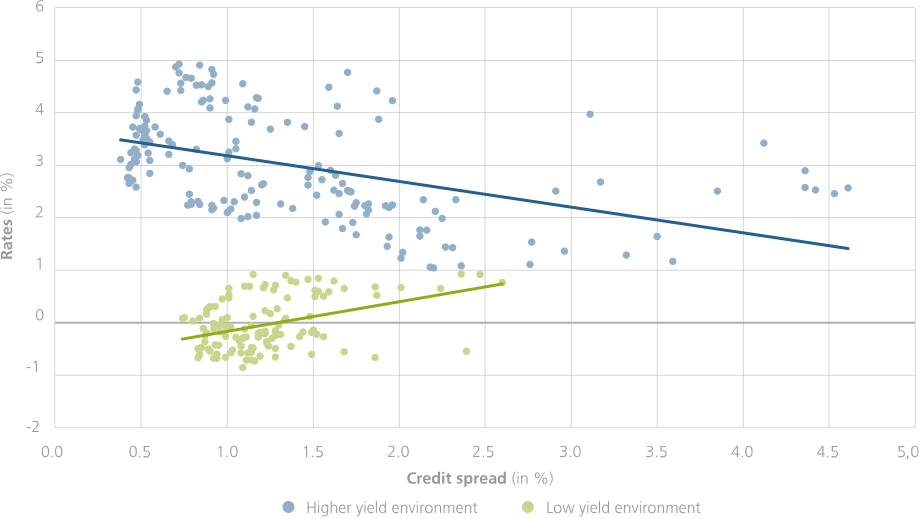
The chart clearly shows the negative correlation between spreads and interest rates in periods of medium and high interest rate levels – the environment in which we currently find ourselves. Economic booms are typically associated with low spreads and high interest rates, while periods of weaker growth usually lead to widening spreads and falling interest rates.
Only during the low interest rate phase, the correlation between spreads and interest rates was positive. During this period, ECB bond purchases covering both corporate and government bonds caused both asset classes to move largely in tandem. Currently, the probability is therefore high that rising spreads – for example during an economic downturn or a crisis – would coincide with falling interest rates.
Scenario analysis: What can be expected for corporate bonds in 2026?
Given a running yield of just over 3% for euro investors and a roll-down return of around 0.5%, returns can be easily calculated as a function of yield changes, as shown in Figure 6:
Figure 6: Return scenarios for IG corporate bonds
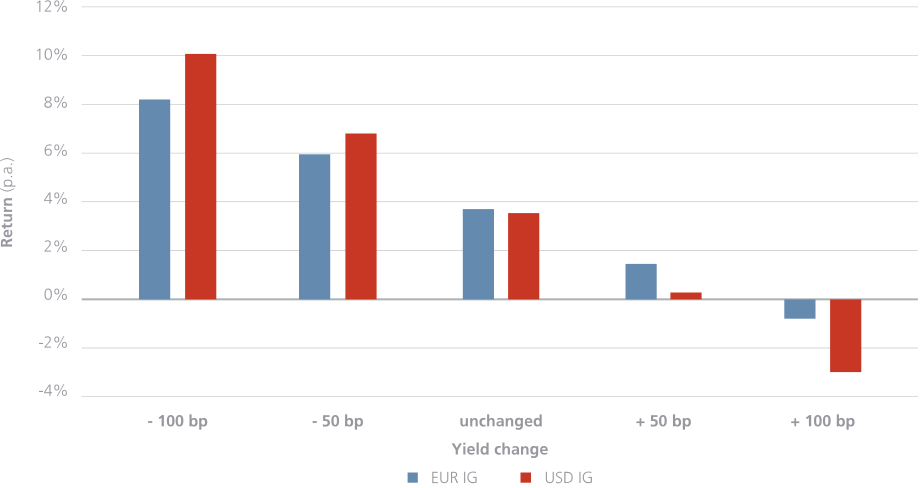
USD IG corporate bonds have a higher average duration than euro IG bonds, so their leverage is greater in both directions in the event of yield changes. Regardless of this, the analysis shows that current yields and expected roll-down returns provide a degree of cushioning in the event of rising yields. Returns would still be positive at 1.5% for euro IG and 0.2% for USD IG if yields in both asset classes rose by 50 basis points by the end of the one-year calculation period.
Conversely, significant yield declines – likely driven by falling interest rates – would result in very attractive returns. A yield decline of one percentage point by the end of the one-year calculation period would translate into annual returns of 8.2% for euro IG and 10.1% for USD IG.
Conclusion
While actual yield movements in 2026 are uncertain and will depend heavily on increasingly erratic political developments worldwide, investors currently find an attractive base yield of between 3.5% and 3.7% in corporate bonds, supported by running yield and a steeper yield curve. This is complemented by returns arising from yield movements over the course of the year. Current yield levels provide a buffer that allows even yield increases of 50 basis points without pushing returns into negative territory. Corporate bonds therefore remain a core component in investors’ asset allocations.