Low spreads or safe haven – corporate bonds in 2026
Credit spreads are currently low measured against government bonds. However, this does not necessarily mean that corporate bonds are unattractive: the risk differential between corporate and government bonds has narrowed due to the increasing challenges faced by the public sector, which justifies lower spreads. A comparison with the swap curve supports this interpretation.

Dr. Harald Henke
Principal Investment Strategist Fixed Income
Key takeaways
-
Low spreads are justified: Sovereign risks have increased, corporate bonds are not too expensive.
-
Advantage of corporates: Many companies have strengthened their balance sheets and reduced debt.
-
New balance in bond markets: Corporate bonds remain attractive despite tight spreads.
Current spread levels
After several years of rallying – interrupted by political events such as trade wars – investment grade (IG) credit spreads have reached low levels in both euros and US dollars. Figure 1 shows the trend over the past 26 years.
Figure 1: IG credit spread levels

As the chart illustrates, euro IG credit spreads are at their lowest level since 2007. Only during the low-spread phase prior to the 2007–2009 financial crisis were they significantly lower. In USD, the current phase marks one of the lowest levels in this century.
This becomes clear in Figure 2, which ranks month-end index spreads since January 2000 in order of magnitude.
Figure 2: Monthly ranking of credit spreads since 2000 | A: Euro IG

Figure 2: Monthly ranking of credit spreads since 2000 | B: USD IG

Euro IG credit spreads currently stand at the 19th percentile (spreads were lower in 19% of all months since January 2000, higher in 81%), while USD IG credit spreads are at the third-lowest level of this century.
Negative credit spreads and sovereign risks
Low credit spreads relative to government bonds have led to several notable cases of negative spreads. For instance, short-dated bonds issued by top-rated US companies such as Microsoft or Walmart, were trading at yields below those of comparable US Treasuries. Similar examples exist for riskier countries such as France, which already have to pay a premium relative to lower-risk sovereigns.
Is this a sign that credit spreads are too low? An alternative explanation looks at the issue from a different perspective: government bonds are increasingly being viewed as less low-risk by the market – even in developed economies. The US government shutdown has unsettled investors, as have fiscal debates in the UK and political uncertainty in France. Austria was downgraded this year, while Germany is caught in a cycle of weak growth, accelerating deindustrialisation, and ambitious spending plans.
If the benchmark against which corporate risk premia are measured becomes riskier, the spread must inevitably narrow – without necessarily implying that corporate bonds are expensive. Likewise, in times of major crisis, investors often flee to the supposed safe havens of the highest-rated government bonds, which normally form the basis for calculating credit spreads. In such cases, an analysis focusing solely on spread levels would view corporate bonds as historically cheap.
Pros and cons of corporate vs. government bonds
Corporate bonds differ fundamentally from government bonds in terms of risk. Some factors make corporate bonds riskier, while others give corporate bond investors an advantage. Key arguments for government bonds include:
- Access to tax revenue: As long as public debt remains manageable and tax income is sufficient to service it, states have a source of revenue unavailable to companies. Corporates, by contrast, must convince investors to finance them voluntarily in exchange for attractive returns.
- Safety nets: Governments have backstops such as the International Monetary Fund or, in the euro area, the ESM, which can support distressed states financially. Often, bond investors from the affected country are not expected to participate in a restructuring. While central banks have also lowered corporate spreads via bond purchase programmes, targeted bailouts remain reserved for states and are used selectively.
- Lower susceptibility to idiosyncratic risk: Management errors occur in both business and politics. However, their impact on a company’s creditworthiness is typically greater. Diversification can mitigate idiosyncratic risks for investors, but the effects are usually less visible in sovereign bonds.
While these major points argue in favour of government bonds as a lower-risk investment, there are also some points where corporate bonds perform better from a risk perspective:
- Creditor protection in default: In the event of bankruptcy, creditors assume control of the company and have claims on its assets. In the case of sovereign defaults, investors’ legal position is weaker, and compensation is often a lengthy political process with uncertain outcomes.
- Stronger market discipline: Companies are subject to stricter capital market discipline than governments and focus on economic performance; there are fewer political constraints to consider when managing a company than when managing a government.
- Financial strength and diversification: Many high-rated companies are broadly diversified, maintain strong liquidity reserves, and prioritise growth – aligning their interests more closely with those of bond investors. Moreover, their leverage relative to economic capacity is often lower than that of most sovereigns.
While these factors generally make government bonds the safer investment, there can come a point when this balance shifts – for example, when debt-servicing costs rise sharply relative to tax revenues, growth prospects deteriorate, and future tax receipts become less certain due to the erosion of economic performance. The current trend points in this direction, suggesting that fair spread levels for corporate bonds should be structurally lower than in the past – particularly as many companies have repaired their balance sheets, reduced debt, and adapted business models since the rate hikes of 2022.
Credit spreads versus the swap curve
To examine this argument more closely, we can compare credit spreads not to government bonds but to the swap curve – which roughly reflects large banks’ funding costs. Since swaps are collateralised transactions, they are considered low-risk and provide a good benchmark for assessing credit risk.
Figure 3 shows credit spreads against the swap curve, known as asset swap spreads (ASW):
Figure 3: Credit spreads vs. swaps (asset swap spreads)

As can be clearly seen, asset swap spreads – particularly in USD – are far from their historic lows. This is also evident in the following ranking:
Figure 4: Monthly ranking of credit spreads over swaps since January 2000 | A: Euro IG
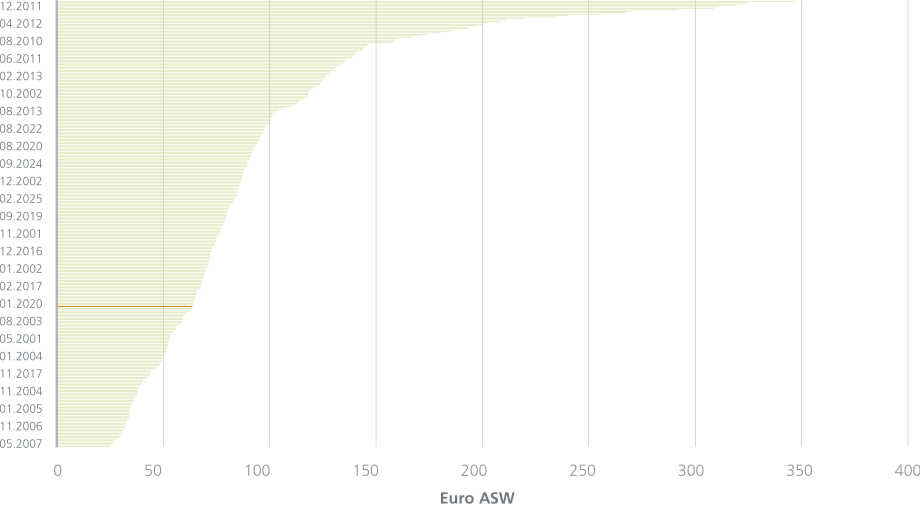
Figure 4: Monthly ranking of credit spreads over swaps since January 2000 | B: USD IG

For euro and USD IG, spreads relative to swaps are at the 34th and 35th percentiles, respectively. Although below the historical average, in both markets more than one-third of all historic observations have been lower. This suggests that corporate bonds are not excessively valued.
A comparison of Figures 1 and 3 reveals that in the US, spreads over swaps are higher than over Treasuries – meaning that swaps show lower yields on average than US government bonds and the swap spread is therefore negative. This phenomenon, persistent for several years, reflects a mix of factors: regulatory (capital requirements make holding Treasuries costlier for banks than entering swaps), supply-related (rapidly rising US debt levels), and demand-related (pension funds and insurers seeking long-term interest rate hedges).
Outlook: Are corporate bonds the new safe haven?
Are corporate bonds becoming the new safe haven? Not quite yet – but the relative risk profile has shifted. As sovereign risk has increased, high-quality corporate bonds appear comparatively less risky. Many companies have strengthened balance sheets, reduced leverage, and benefitted from a historically high ratio of rating upgrades to downgrades. Large multinationals continue to generate robust profits and maintain solid growth prospects.
Moreover, globally diversified corporations are better positioned to navigate geopolitical challenges than many states. By relocating production to favourable regions and using regulatory arbitrage, they – and their bond spreads – have weathered recent market volatility, such as the flare-up of trade tensions in April this year, remarkably well.
Looking solely at spread levels does not tell the whole story. From a risk perspective, investors should therefore consider corporate bonds as an integral component of their fixed income allocation.