High yield bonds – a buffer for rising yields
Due to the historically low spread levels of high yield corporate bonds, many investors have adopted a cautious stance towards this asset class. However, the high yield level of the asset class offers a buffer against yield increases, which opens interesting strategic opportunities for investors, as Dr Harald Henke explains.


Dr. Harald Henke
Principal Investment Strategist Fixed Income
Current high yield environment
The high yield market has been the focus of many investors in recent weeks. Following a remarkable rally, most recently fuelled by Donald Trump’s election victory and the expectation of business-friendly politics, high yield spreads have reached a historically low level.
Figure 1: Global high yield spreads and yields for Euro investors

The chart shows daily spreads and yields of the global high yield index. As can be seen, spreads are historically at a low level. Only the phase before the financial crisis showed even lower spreads. Calculated on a daily basis, spreads have only been lower than today in 7.8 % of cases since the beginning of 2001. This has deterred many investors from investing in the high yield bond asset class.
The chart also shows the yield level of high yield bonds with a currency hedge. The yield is made up of the credit spread and the interest yield of the index. As the latter is now well above the level of the negative interest rate phase, high yield yields are not low by historical standards. On 30 % of the days since the beginning of 2001 we have had lower yields than today.
Historical performance of high yield bonds
This raises the question of how high yield bonds can be expected to perform in the future. High yield offers a higher return than investment grade (IG) bonds but is also more volatile. This is illustrated by the historical annual returns of both asset classes.
Figure 2: Historical annual performance high yield and investment grade

Figure 2 shows that high yield bonds have outperformed IG bonds in seven of the last nine years. The asset class performed better both in the weak interest rate year 2022 and in the rebound years 2023 and 2024. IG bonds were stronger in years of sharp interest rate declines due to the higher duration of the IG index. On the other hand, high yield bonds performed weaker in phases of very strong spread widening, such as in the 2001/02 and 2007/08 crises.
This is also to be expected, as the spread component makes a greater contribution to the overall volatility of high yield bonds than IG. While around two-thirds of the volatility in the IG segment is attributable to interest rates and one-third to spreads, the spread component dominates in the high yield segment, as illustrated in Figure 3.
Figure 3: Return components of high yield bonds

Scenario analysis for high yield bonds
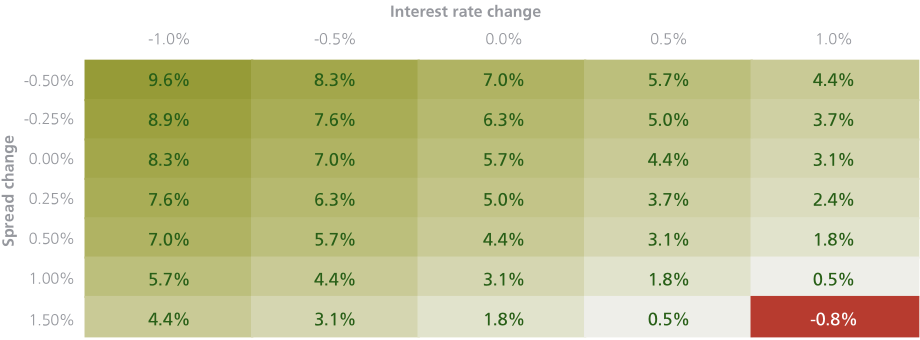
So, in which scenarios would high yield bonds deliver a negative performance for investors given the low spread level in 2025? And what impact would potential interest rate declines have on the returns realised? Figure 4 shows a scenario analysis for the ICE BofA Global High Yield Index (EUR hedged). Various spread and interest rate changes are assumed and the returns calculated. In the first table, it is assumed that the change in yield is linear over time, so that the carry changes over time. In the second case, the change in yield occurs at the end of the year, which represents a worst-case scenario for yield increases, as investors would only earn the negative performance from the change in yield, but not the higher yields in 2025.
Figure 4: Scenario analysis for high yield bonds
Panel A: Even increase in returns over the year 2025
Panel B: Sharp rise in yields at the end of 2025
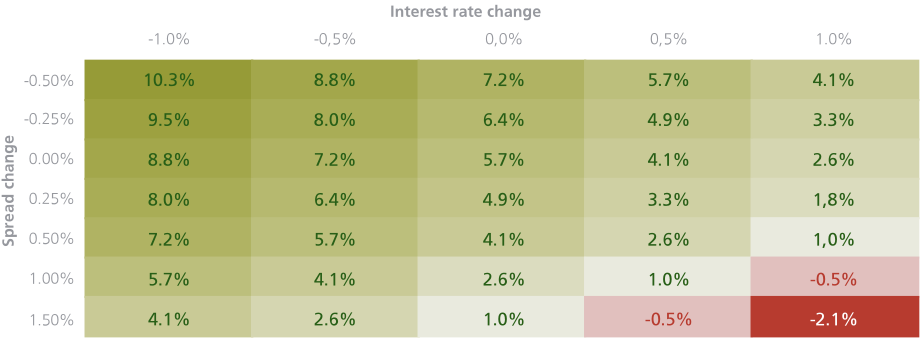
In the scenario analysis, interest rate change scenarios are analysed within a range of +1 % to -1 %. Due to the low spread level, the spread change range is defined asymmetrically and lies between a narrowing of 50 basis points and a widening of 150 basis points.
As can be seen from the tables, a high yield investor earns 5.7 % if spreads and interest rates do not change over the next year. In the event of a two per cent increase in yields (e.g. due to a spread widening of 1.5 percentage points and an interest rate increase of 50 basis points), an investor would still be left with 0.5 % return if the yield increase takes place evenly over time. In the event of a sharp rise at the end of the year, the return on the investment for 2025 would be a moderate -0.5 %.
As can be seen, the current yield levels offer a considerable buffer against yield increases, which would only bring the return on the investment into negative territory in 2025 in the event of sharp rises.
Summary
While high yield spreads are historically low, the yield level of this asset class is still adequate. The high yield helps investors to absorb potential increases in yields, whether due to a resurgence of inflation or a rise in spreads. Negative total returns are therefore only to be expected if yields rise noticeably by more than 2 percentage points. This buffer explains why high yield bonds have performed better than IG bonds in recent years. Investors who want even greater protection against yield rises can use a short duration high yield strategy as a further downside hedge.


