Market commentary bonds: Interest rates in step? Why the eurozone and the US are diverging
While the US is supporting the economy with falling key interest rates, the rate-cutting cycle in the eurozone has come to an end – despite uncertain outlook. Corporate bonds could benefit from the rising risk associated with sovereign issuers.

Dr. Harald Henke
Principal Investment Strategist Fixed Income
Key takeaways
-
Interest rates are diverging: The Fed continues to cut, while the ECB pauses – euro yields are rising and the US yield curve is steepening.
-
Europe remains economically weak: leading indicators are deteriorating, with Germany edging closer to recession.
-
Credit gains importance: higher sovereign risk and solid corporate balance sheets support corporate bonds.
Interest rates: Divergence between currency areas
On the interest rate front, the decoupling between the eurozone and the US was particularly striking in the fourth quarter of 2025. While the Fed took the third interest rate cut of the cycle in December, lowering the US key interest rate to 3.5-3.75%, the ECB signalled the likely end of the rate-cutting cycle in Europe. While the key interest rate is likely to remain unchanged for the foreseeable future, ECB member Isabel Schnabel unsettled markets in early December when she suggested in an interview that, in her view, the next ECB policy move should be an increase.
As a result, German yields rose in the fourth quarter of 2025, as shown in Figure 1.
Figure 1: Yield and curve steepness in Germany
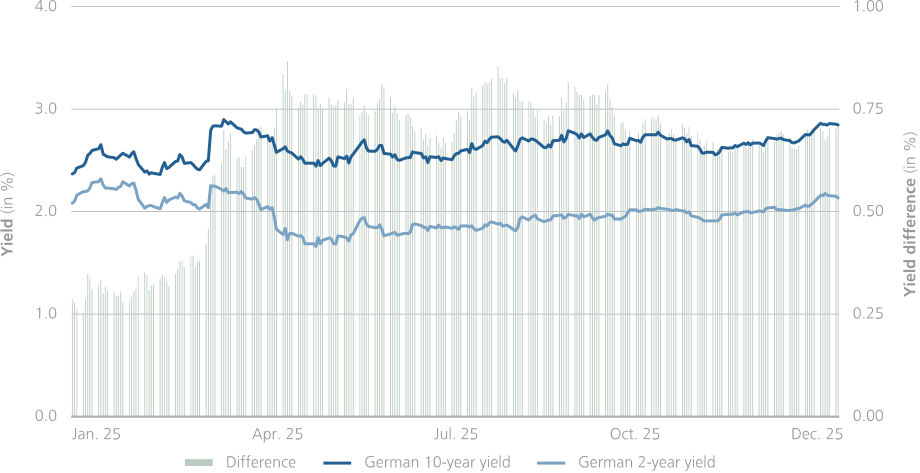
The German ten-year yield increased from 2.71% to 2.86% in the fourth quarter, while two-year yields increased from 2.02% to 2.12%. In the US, bond markets exhibited a different dynamic, as illustrated in Figure 2:
Figure 2: Yield and curve steepness in the US

In the US, ten-year yields moved sideways, ending the month at 4.13% after 4.17% at the end of September. By contrast, the two-year yield declined from 3.61% to 3.47%. This resulted in a re-steepening of the US yield curve, with the spread between ten- and two-year yields now standing at around 70 basis points – broadly in line with German levels.
Dot plots: Unchanged interest rate expectations of the US Federal Reserve
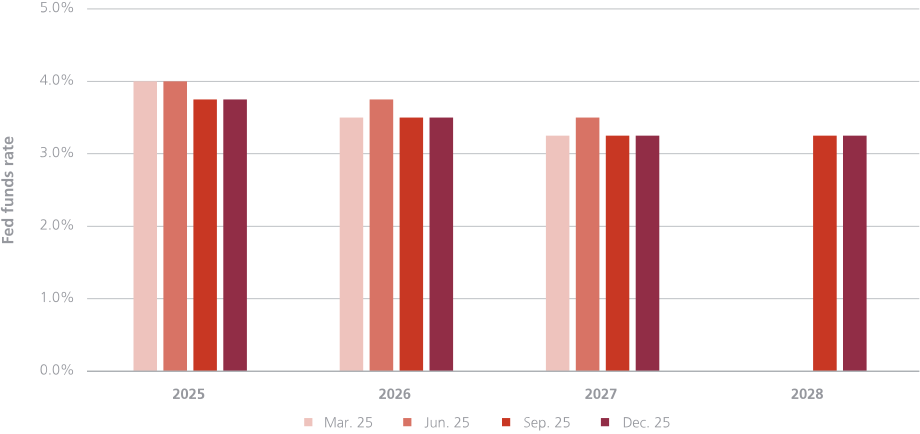
Alongside its December interest rate decision, the Federal Reserve published its quarterly updated key interest rate estimates of its members (known as “dot plots”). While the figures remained unchanged from the September estimate, interest rate expectations are slightly lower than they were in mid-year. This signals the Fed’s continued cautious stance regarding future economic and inflation developments.
Figure 3: Median Fed dot plot
Economic developments
Growth on both sides of the Atlantic has been moderately positive. However, leading economic indicators such as the purchasing managers’ indices have cooled off again recently, as can be seen in Figure 4.
Figure 4: Purchasing managers’ indices for the manufacturing sector
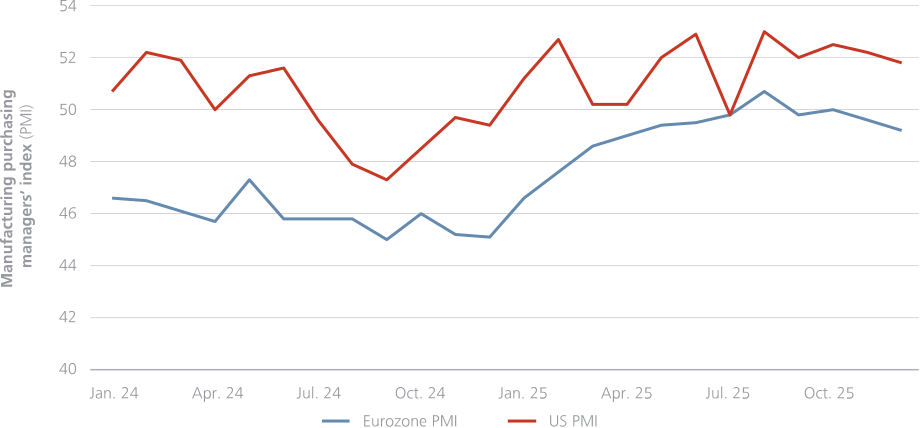
Purchasing manager indices for both the United States and the euro area have declined in recent months. In the US, the index remains above the expansion threshold of 50, whereas the euro area index has slipped back into contraction territory after only briefly rising above 50 in the third quarter.
European industry continues to face significant challenges. A loss of competitiveness due to the disappearance of affordable energy has led to a sharp increase in corporate insolvencies in the euro area since mid-2022.
Figure 5: Corporate bankruptcies in the EU
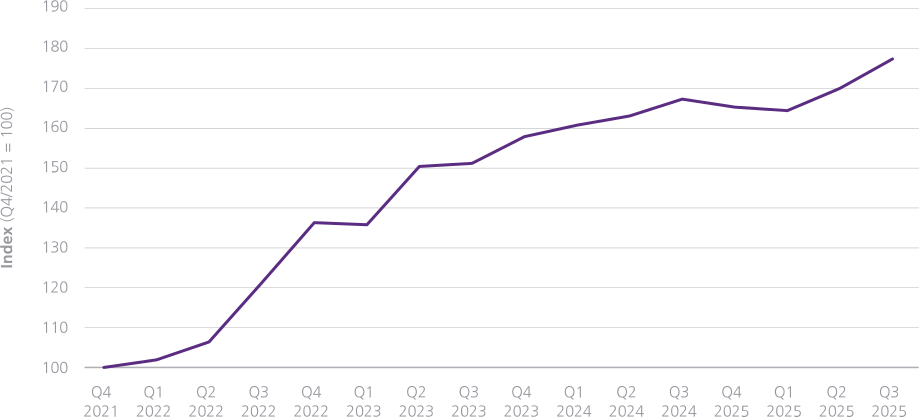
While the eurozone is expected to achieve real growth of over one per cent for the first time in three years, Germany remains close to recession level with a forecast increase of 0.3 % after two years of negative growth.
Credit spreads remain low – for good reason
Risk premia on investment-grade (IG) corporate bonds (“credit spreads”) declined further from already low levels in the fourth quarter.
Figure 6: Credit spread of IG corporate bonds
Panel A: Euro IG
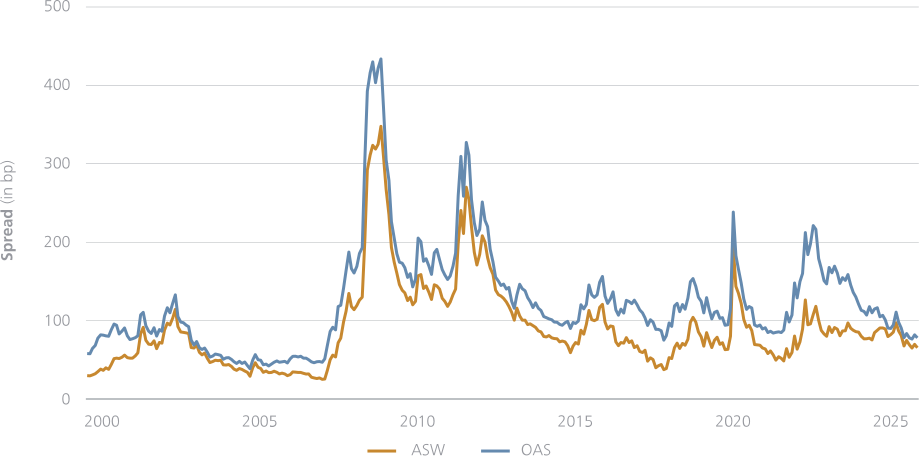
Panel B: USD IG

For euro IG credit, spreads over the government bond curve are at historically low levels, with only the period before the financial crisis in 2004 to 2007 seeing lower levels. In around 80% of historical observations, credit spreads were higher than they are today. USD credit spreads are even closer to all-time lows, with spreads lower than current levels in only 2% of cases.
While this may make credit spreads appear unattractive at first glance, a more detailed analysis reveals a more nuanced picture. The corporate balance sheet quality has improved noticeably in recent years, which justifies lower spreads. More importantly, government bonds – which serve as the reference point for calculating credit spreads – have become significantly riskier due to fiscal excesses, weak growth and heightened geopolitical tensions.
When credit spreads in Figure 6 are compared against swap curves rather than government bond curves, they still appear slightly below historical averages but remain far from historic lows. In 33% of cases for euro IG credit and 35% for USD IG credit, spreads versus swaps were lower than today. This suggests that historical comparisons based on government bond curves should be treated with caution, given the changed risk profile of sovereign bonds.
Outlook
Weak growth in Europe amid rising interest rates: The eurozone faces a difficult year in 2026. Although the European Commission and the ECB forecast real growth of 1.2–1.4%, history shows that such projections have often proved overly optimistic. Whether Europe can expect support from the United States in 2026 remains uncertain in light of US tariff policy and the newly published National Security Strategy, which adopts a more critical stance towards Europe. The elevated risk associated with government bonds argues in favour of partially replacing them with corporate bonds within the lower-risk segment of portfolios.